

Taking place in the heart of Namur, the event will span two exciting days, with a diverse program, designed to offer a dynamic and interactive experience for all participants.
The whole symposium will be held in English.
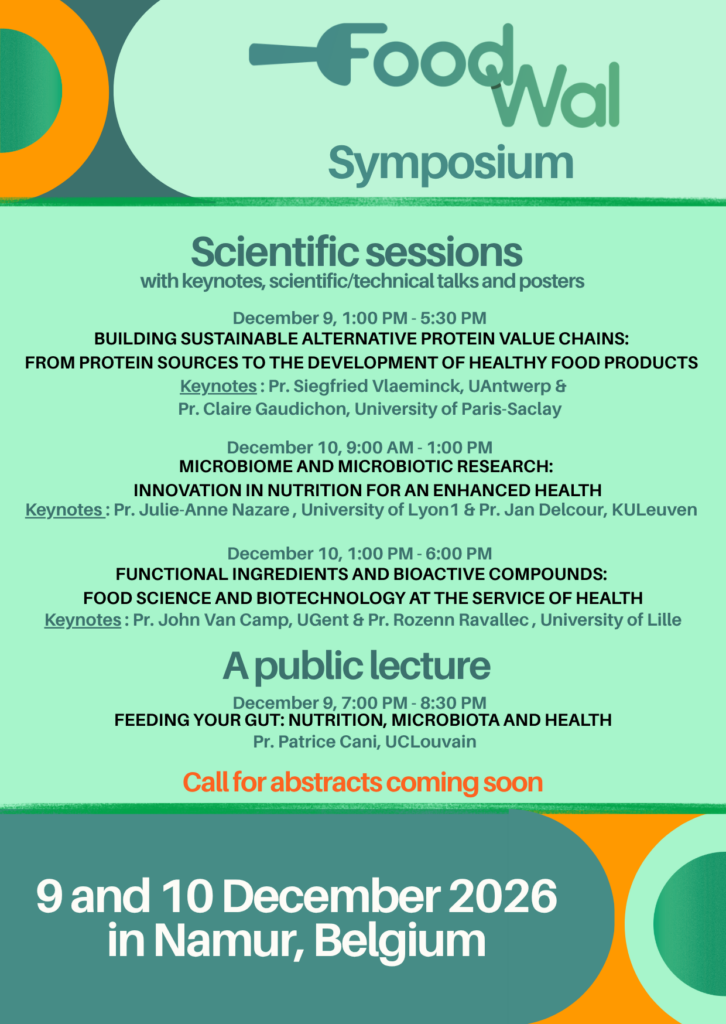
On Wednesday 9th and Thursday 10th December, two scientific and technical days will be held, focusing on the themes of alternative proteins, the microbiome, and functional ingredients.
On Wednesday evening, a general public conference will be held in English, being accessible to non-specialists, with the aim to popularise the latest research in nutrition and health.
Hungry for more ? For senior scientists and group leaders, we organise a third day (on December 11) focused on international collaboration, including lab visits and a workshop dedicated to the building-up of structured collaborative projects. A specific registration is requested, you can find more information here !
Please note that the deadline for registration is November 13. Register here !
The scientific program
| Day 1 – Wednesday, 9 December 2025 | |
| 12:00 | Welcome & Lunch |
| 13:00 | FoodWal Retrospective |
| 13:15 | Policy & Funding Insights: Wagralim, WBI, SPW |
| 13:40 | Alternative Proteins Session Context & Projects Overview: Baptiste Leroy |
| 14:20 | Lecture: Siegfried Vlaeminck “title to be confirmed” |
| 15:00 | Poster Spotlight |
| 15:10 | Break & Poster Viewing |
| 15:30 | Short Talk #1 |
| 15:40 | Short Talk #2 |
| 15:50 | Short Talk #3 |
| 16:00 | Short Talk #4 |
| 16:10 | Short Talk #5 |
| 16:20 | Q&A |
| 16:30 | Lecture: Claire Gaudichon “title to be confirmed” |
| 17:10 | Industry Tour #1: Alternative Proteins |
| 17:25 | Drinks & Walking Dinner |
| 19:00 | Public Lecture: Patrice Cani “Feeding your gut: nutrition, microbiota and health” |
| 20:30 | close |
| Day 2 – Thursday, 10 December 2025 | |
| 09:00 | Welcome |
| 09:30 | Microbiome Session Context & Projects Overview: Nathalie Delzenne |
| 10:00 | Lecture: Julie-Anne Nazare “From Microbiota-Targeted Nutritional Interventions to Host Effects: The Value of Integrated Multi-Marker Signatures” |
| 10:40 | Poster Spotlight |
| 10:50 | Break & Poster Viewing |
| 11:10 | Short Talk #1 |
| 11:20 | Short Talk #2 |
| 11:30 | Short Talk #3 |
| 11:40 | Short Talk #4 |
| 11:50 | Short Talk #5 |
| 12:00 | Q&A |
| 12:10 | Lecture: Jan Delcour “AXOS: From wheat bran to arabinoxylan oligosaccharides (AXOS): production, prebiotic effect, regulatory aspects and spinout creation” |
| 12:50 | Lunch |
| 13:40 | Functional Ingredients Session Context & Projects Overview: Nathalie Gillard/Gauthier Eppe |
| 14:20 | Lecture: John Van Camp “title to be confirmed” |
| 15:00 | Poster Spotlight |
| 15:10 | Break & Poster Viewing |
| 15:30 | Short Talk #1 |
| 15:40 | Short Talk #2 |
| 15:50 | Short Talk #3 |
| 16:00 | Short Talk #4 |
| 16:10 | Short Talk #5 |
| 16:20 | Q&A |
| 16:30 | Lecture: Lecture: Rozenn Ravallec “Bioactive peptides (BAPs) : challenge and opportunities in a context of agroressources valorisation” |
| 17:10 | Industry Tour #1: Microbiome & Functional Ingredients Sectors |
| 17:40 | Closing remarks |
| 18:00 | Networking drink |
The thematic sessions

Session 1 – Building sustainable alternative protein value chains: from protein sources to the development of healthy food products
This scientific session will present (i) scientific and technological advances in creating and characterising alternative protein sources and products, and (ii) socio-economic insights on the development, maintenance and growth of sustainable alternative protein value chains, both in a one health context.
The session will focus on a variety of topics, including:
- Nutritional and techno-functional quality of alternative proteins
- Alternative protein digestibility, bioaccessibility and bioavailability
- Cutting-edge technologies designed to produce and process alternative protein sources
- Development of attractive, innovative and healthy alternative protein-made products
- Circular economy and valorisation of protein-rich byproducts from the food industry
- Building sustainable alternative protein value chains
- Impact of the social, societal acceptance and of (r)evolution of food habits in the development, maintenance and growth of alternative protein value chains
- Numeric innovations in the alternative protein sector

Session 2 – Microbiome and microbiotic research: innovation in nutrition for an enhanced health
This scientific session will present (i) scientific advances in characterising, understanding and modulating the microbiome and (ii) cutting-edge technologies designed to develop innovative microbiotics, both in a one health context.
The session will focus on a variety of topics, including:
- Microbiome characterisation
- Microbiome in health and disease
- Understanding the links between microbiota, diet and health
- Advances in microbiome-related techniques
- Innovative microbiotic development and characterisation
- Technological challenges in the microbiotic sector
- Numeric innovation in the microbiotic and microbiome sectors
- Impact of social/societal acceptance in the development of innovative microbiotics

Session 3 – Functional ingredients and bioactive compounds: food science and biotechnology at the service of health
This scientific session will present (i) scientific advances in identifying, characterising and understanding mechanisms of action of functional ingredients, and (ii) cutting-edge technologies designed to develop and produce innovative functional ingredients, both in a one health context.
The session will focus on a variety of topics, including:
- Functional ingredients and bioactive compounds: sourcing, identification, production, extraction, characterisation, formulation and integration in complex matrices
- Development of innovative bioactive peptides: synthesis, engineering, screening, sourcing, production methods, identification, structural and functional analyses and bioactivity assessment
- Circular economy and valorisation of by-products from the food industry
- Evaluation of the biological, nutritional and health effects of functional ingredients or bioactive compounds
- Cutting-edge biotechnologies: precision fermentation, innovative enzymatic techniques, microbial engineering, etc.
- Numeric innovations in the functional ingredient sector