

The symposium being held in English, the pages related to this event are available in English only.
Taking place in the heart of Namur, the event will span two exciting days, with a diverse program, designed to offer a dynamic and interactive experience for all participants.
The whole symposium will be held in English.
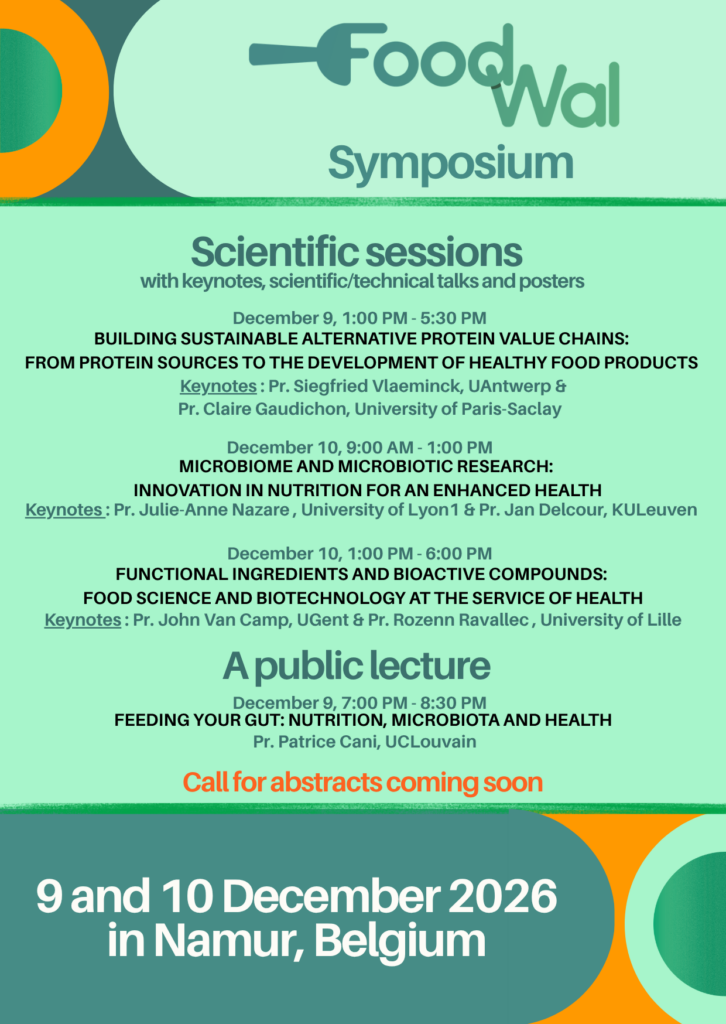
On Wednesday 9th and Thursday 10th December, two scientific and technical days will be held, focusing on the themes of alternative proteins, the microbiome, and functional ingredients.
On Wednesday evening, a general public conference will be held in English, being accessible to non-specialists, with the aim to popularise the latest research in nutrition and health.
Hungry for more ? For senior scientists and group leaders, we organise a third day (on December 11) focused on international collaboration, including lab visits and a workshop dedicated to the building-up of structured collaborative projects. A specific registration is requested, you can find more information here !
Please note that the deadline for registration is November 13. Register here !
The scientific program
| Day 1 – Wednesday, 9 December 2025 | |
| 12:30 | Badge pick-up and welcome coffee |
| 13:00 | FoodWal Retrospective |
| 13:15 | Policy & Funding Insights: Wagralim, WBI |
| 13:40 | Alternative Proteins Session Context & Projects Overview: Baptiste Leroy |
| 14:20 | Lecture: Siegfried Vlaeminck – title to be confirmed |
| 15:00 | Poster Spotlight |
| 15:10 | Break & Poster Viewing |
| 15:30 | Zied Zaraï – Functional and nutritional properties of proteins from Phormidium versicolor for sustainable food innovation |
| 15:40 | Guillermo Santos Sanchez – Effect of ingredient processing on in vivo protein quality of chickpeas and lentils in rats |
| 15:50 | Guillaume Bayon-Vicente – Upcycling sugar beet molasses into single-cell protein with a glucose-adapted Rhodospirillum rubrum: process optimisation and production cost analysis |
| 16:00 | Olivier Talon – Nutritional Life Cycle Assessment approaches applied to the evaluation of the environmental relevance of food products based on purple bacteria |
| 16:10 | Louise Dye – Understanding and enabling wider acceptance of Alternative Proteins (AP) by the consumer |
| 16:20 | Q&A |
| 16:30 | Lecture: Claire Gaudichon – Evaluating Alternative Protein Sources: Why and How. From Theory to Practice |
| 17:10 | Industry Tour #1: Alternative Proteins Parag Acharya – Protein blend and hybrid alternative protein for next generation meat alternative Maxime Gavage – A multidisciplinary framework for allergenicity assessment of alternative proteins |
| 17:25 | Drinks & Walking Dinner |
| 19:00 | Public Lecture: Patrice Cani – Feeding your gut: nutrition, microbiota and health |
| 20:30 | Closing |
| Day 2 – Thursday, 10 December 2025 | |
| 09:00 | Welcome coffee |
| 09:30 | Microbiome Session Context & Projects Overview: Nathalie Delzenne |
| 10:00 | Lecture: Julie-Anne Nazare – From Microbiota-Targeted Nutritional Interventions to Host Effects: The Value of Integrated Multi-Marker Signatures |
| 10:40 | Poster Spotlight |
| 10:50 | Break & Poster Viewing |
| 11:10 | Annaïg Lan – Impact of consuming native or processed seaweed on the environment of the large intestine in rats |
| 11:20 | Josep Rubert – Specialized gut microbes remodel dietary linoleic acid into more highly unsaturated fatty acids and complex lipids |
| 11:30 | Manon Autuori – Investigation of breath composition following ingestion of purple bacteria as a new source of essential nutrients |
| 11:40 | Léonie Lang – Translational Potential of Microbiome-Based Biomarkers: Current Status and Limitations |
| 11:50 | Lucia Cocorullo – Prebiotic galacto-oligosaccharides: from enzymatic synthesis to mass spectrometry-based structural characterisation |
| 12:00 | Q&A |
| 12:10 | Lecture: Jan Delcour – AXOS: From wheat bran to arabinoxylan oligosaccharides (AXOS): production, prebiotic effect, regulatory aspects and spinout creation |
| 12:50 | Lunch |
| 13:40 | Functional Ingredients Session Context & Projects Overview: Nathalie Gillard/Gauthier Eppe |
| 14:20 | Lecture: John Van Camp – Use of advanced cell culture models to study bioavailability and bioactivity of bioactives and their metabolites |
| 15:00 | Poster Spotlight |
| 15:10 | Break & Poster Viewing |
| 15:30 | Thomas Tilmant – Structure-informed profiling of prebiotic food oligosaccharides by UHPLC-FLR-HRMS: from ingredient fingerprints to probiotic utilization patterns |
| 15:40 | Bryan Renard – PAGTAL: An AI model for the Rational Identification of Bioactive Peptides |
| 15:50 | Claire Cauwelier – Marine collagen peptide supplementation selectively enhances intestinal barrier markers without conferring protection against acute inflammation or western diet-induced metabolic disorders |
| 16:00 | Veva Jaeken – From single-foods to meals: Effect of meal matrix pH, viscosity, and tomato polyphenols on the in vitro starch and protein digestion kinetics of isolated cotyledon cell lentil flour |
| 16:10 | Christine Bosch – Sustainable Polyphenols for Improved Nutrition Across the Lifespan (SPINLife) |
| 16:20 | Q&A |
| 16:30 | Lecture: Lecture: Rozenn Ravallec – Bioactive peptides (BAPs) : challenge and opportunities in a context of agroressources valorisation |
| 17:10 | Industry Tour #2: Microbiome & Functional Ingredients Laurence Lins – Be-Life: a food supplement industry dedicated to support health and sustainability Guillaume Bayon-Vicente – PurpleTech: purple bacteria as a natural source of bioactive compounds for metabolic health Carolyne Dubreuil – Bridging academia, industry, and government: RITA’s collaborative approach to food innovation |
| 17:40 | Closing remarks – best poster and best oral communication awards |
| 18:00 | Networking drink |
The thematic sessions

Session 1 – Building sustainable alternative protein value chains: from protein sources to the development of healthy food products
This scientific session will present (i) scientific and technological advances in creating and characterising alternative protein sources and products, and (ii) socio-economic insights on the development, maintenance and growth of sustainable alternative protein value chains, both in a one health context.
The session will focus on a variety of topics, including:
- Nutritional and techno-functional quality of alternative proteins
- Alternative protein digestibility, bioaccessibility and bioavailability
- Cutting-edge technologies designed to produce and process alternative protein sources
- Development of attractive, innovative and healthy alternative protein-made products
- Circular economy and valorisation of protein-rich byproducts from the food industry
- Building sustainable alternative protein value chains
- Impact of the social, societal acceptance and of (r)evolution of food habits in the development, maintenance and growth of alternative protein value chains
- Numeric innovations in the alternative protein sector

Session 2 – Microbiome and microbiotic research: innovation in nutrition for an enhanced health
This scientific session will present (i) scientific advances in characterising, understanding and modulating the microbiome and (ii) cutting-edge technologies designed to develop innovative microbiotics, both in a one health context.
The session will focus on a variety of topics, including:
- Microbiome characterisation
- Microbiome in health and disease
- Understanding the links between microbiota, diet and health
- Advances in microbiome-related techniques
- Innovative microbiotic development and characterisation
- Technological challenges in the microbiotic sector
- Numeric innovation in the microbiotic and microbiome sectors
- Impact of social/societal acceptance in the development of innovative microbiotics

Session 3 – Functional ingredients and bioactive compounds: food science and biotechnology at the service of health
This scientific session will present (i) scientific advances in identifying, characterising and understanding mechanisms of action of functional ingredients, and (ii) cutting-edge technologies designed to develop and produce innovative functional ingredients, both in a one health context.
The session will focus on a variety of topics, including:
- Functional ingredients and bioactive compounds: sourcing, identification, production, extraction, characterisation, formulation and integration in complex matrices
- Development of innovative bioactive peptides: synthesis, engineering, screening, sourcing, production methods, identification, structural and functional analyses and bioactivity assessment
- Circular economy and valorisation of by-products from the food industry
- Evaluation of the biological, nutritional and health effects of functional ingredients or bioactive compounds
- Cutting-edge biotechnologies: precision fermentation, innovative enzymatic techniques, microbial engineering, etc.
- Numeric innovations in the functional ingredient sector